



Chardonnay, Main Divide Wines, New Zealand, New Zealand Wines, New Zealand wines, Waipara, white wines, Wine and Dine, Wine and Food
Asparagus Quiche with Wild Garlic Filling & Parmesan Shortcrust Pastry

May
Seasonal precision on the plate—and a Burgundy Chardonnay from the ends of the earth
Wine from New Zealand has nothing to prove when it’s as impressive as the Main Divide Chardonnay from the Waipara Valley. Many people think of New Zealand’s South Island as Sauvignon Blanc territory—yet in the lee of the Southern Alps, on chalky soils between limestone and volcanic rock, grows one of the most compelling Chardonnays in the Southern Hemisphere. The dish to pair with it is no compromise: a Parmesan shortcrust pastry that crunches, a filling of wild garlic and white asparagus that smells of spring, eggs and cream that hold it all together. A quiche that demands to be taken seriously—just like the wine that accompanies it.
Ideal wine pairing: Main Divide Chardonnay (Waipara Valley, Canterbury, New Zealand)
Main Divide is the local name for the Southern New Zealand Alps—the backbone of the South Island, which shapes the region’s climate, soils, and character. The grapes for this Chardonnay come from the Waipara Valley, one of Canterbury’s most exciting wine-growing regions: vineyards selected for their ability to express the region’s character directly in the glass. The winemaking process strictly follows Burgundian tradition: The grapes are hand-harvested, gently pressed without destemming, and the juice is immediately transferred to French barriques for natural fermentation. This is also where the wine undergoes lees aging and malolactic fermentation. Twelve months of barrel aging complete the maturation process—more time than many wineries can afford today.
In the glass, the 2018 vintage displays a brilliant golden-yellow color with green highlights. The bouquet is fruit-forward and inviting: peach, apricot, and lemon take center stage, followed by fig and dried fruit, underpinned by vanilla, hazelnut, a subtle toasty note, and a hint of crisp minerality. On the palate, it is juicy and round, wonderfully balanced and intense—the creaminess from the lees aging carries the wine, the refreshing acidity maintains the balance, and the finish is long and complex. This is exactly the kind of wine that calls for a dish with depth: the Parmesan in the shortcrust pastry picks up on the hazelnut and toast, the wild garlic responds to the minerality, and the asparagus to the acidity. No coincidence—a kinship.
The recipe:
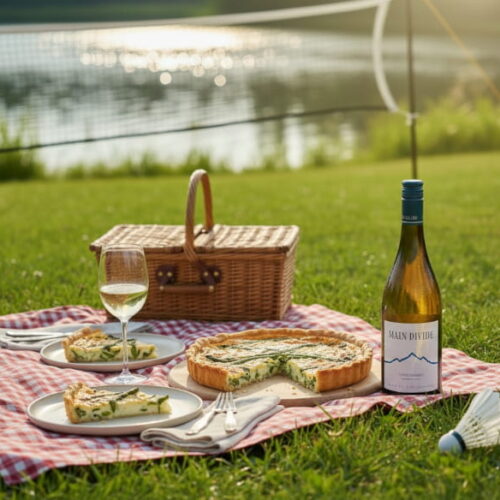
Asparagus Quiche with Wild Garlic Filling & Parmesan Shortcrust Pastry
Equipment
- 1 Quiche-Form (Ø 26 cm, mit herausnehmbarem Boden)
- 1 Nudelholz
- 1 Topf zum Blanchieren des Spargels
- 1 Schüssel für den Teig
- 1 Mixer oder Stabmixer für die Bärlauchcreme
- Backpapier und Hülsenfrüchte zum Blindbacken
Ingredients
FOR THE PARMESAN SHORTCRUST PASTRY:
- 200 g wheat flour Type 405
- 100 g cold butter diced
- 60 g Parmesan cheese finely grated
- 1 Egg Medium Size
- ½ teaspoon of salt
- 1 A pinch of nutmeg freshly grated
- 2 –3 tablespoons of ice-cold water
FOR THE WILD GARLIC AND ASPARAGUS FILLING:
- 500 g white asparagus peeled, cut into 4-cm-long pieces
- 1 A bunch of fresh wild garlic about 60 g leaves, coarsely chopped
- 3 Eggs Medium Size
- 200 ml whipped cream
- 100 g Crème fraîche
- 60 g Parmesan cheese finely grated
- 1 Tablespoon of Dijon mustard
- Salt white pepper, nutmeg
- 1 Tablespoon of olive oil
- Zest of ½ lemon
Instructions
FOR THE SHORTCRUST PASTRY:
- Combine the flour, salt, and nutmeg in a bowl. Add the cold butter cubes and grated Parmesan, and quickly rub them in with your fingertips until the mixture resembles coarse crumbs—the dough should remain cool. Add the egg and ice-cold water one spoonful at a time until the dough just comes together into a ball. Do not knead for too long. Wrap in plastic wrap and let rest in the refrigerator for 30 minutes.
FOR THE ASPARAGUS:
- Blanch the peeled asparagus in lightly salted, boiling water for 5–6 minutes—it should still be slightly firm to the bite. Remove, rinse under cold water, and drain well. Pat dry, toss briefly with olive oil and lemon zest, and set aside.
FOR THE WILD GARLIC CREAM:
- Coarsely chop the wild garlic leaves. In a tall bowl, use a hand blender to purée them with the eggs, cream, crème fraîche, Dijon mustard, half the Parmesan, salt, pepper, and nutmeg until smooth. Taste and adjust seasoning—the cream should have a strong wild garlic flavor.
BLIND RIVETING AND FINISHING:
- Preheat the oven to 190°C (top and bottom heat). Roll out the chilled dough on a floured surface to about 30 cm in diameter and line the greased quiche pan with it, pulling the edges up. Prick the bottom of the dough several times with a fork. Place parchment paper on top, fill with dried beans, and blind-bake the dough for 12 minutes. Remove the parchment paper and beans, and let it dry for another 5 minutes.
FILLING AND BAKING:
- Spread the asparagus evenly over the pre-baked crust. Pour the wild garlic cream over the top. Sprinkle the remaining Parmesan evenly over the top. Bake at 180°C for 30–35 minutes, until the filling has set and the surface is golden brown. Let it rest briefly before cutting into it.
SERVE:
- Serve the quiche lukewarm—room temperature is ideal for both the dish and the wine. Serve with a green leaf salad dressed with lemon vinaigrette.
- Serve the Main Divide Chardonnay at 11–12 °C; open the bottle at least 20 minutes before drinking.
SIDE DISHES:
- Green leaf lettuce with lemon vinaigrette
- Thinly sliced radishes on top of the salad
Nutrition
